Glycerin is in almost everything. Cleansers, toners, moisturisers, serums, soap, toothpaste.
It is one of the most effective and best tolerated humectants we have, which is why formulators reach for it constantly. It is also one of the hardest ingredients to trace, because the same molecule comes from three completely different places.
Vegetable and synthetic glycerin are permissible. Animal-derived glycerin depends on the species and slaughter. Because the finished molecule is identical in all three cases and labels rarely state a source, the practical route is to look for stated vegetable glycerin, a vegan certification, or halal certification of the whole product.
Three sources, one molecule
| Source | Made from | Status |
|---|---|---|
| Vegetable glycerin | Palm, coconut, soy or rapeseed oil | Permissible |
| Synthetic glycerin | Petrochemical feedstock, no animal input | Permissible |
| Animal glycerin | By-product of rendering fats, frequently tallow | Depends |
There is no lab test a consumer can run and no clue in how the product feels. The only thing that distinguishes them is documentation.
What glycerin actually does for skin
Worth knowing, because it explains why removing it is rarely the right move and why it needs something layered over the top.
Glycerin is a humectant. It pulls water into the upper layers of skin, from the deeper tissue and from the air. That is why it makes skin feel immediately plump and soft.
The catch is that a humectant on its own can make dry skin worse in dry air. With nothing to seal it, the water it attracts simply evaporates, and it can pull moisture up from deeper layers on the way. Glycerin needs an occlusive over it to hold the water in place. This is the single most common mistake in a routine built entirely from lightweight products.
Why this one is genuinely debated
Glycerin is the classic case for istihala, the principle that genuine chemical transformation can change a ruling.
When fat is saponified it is split into soap and glycerin through a real chemical reaction. The output is a different substance from the input, not a purified version of it. On that basis many scholars hold the resulting glycerin is permissible regardless of the original fat. Others hold that the source still governs, particularly where the origin is known to be impermissible rather than merely unverified.
Both positions are held by serious scholars. If you want to know which to follow, ask yours. What we can tell you is how to avoid needing to decide.
How to check
- Look for vegetable glycerin stated explicitly. Brands using it usually say so, because it costs more.
- A certified vegan product contains no animal glycerin. That does not make it halal overall, but it settles this ingredient.
- Halal certification covers this and every other derived ingredient at once.
- A bare glycerin on an INCI list tells you nothing at all.
- A brand that cannot answer a sourcing question within a day probably does not know.
What to actually ask a brand
Most sourcing enquiries get a vague reply because the question was vague. This one is hard to deflect:
"Is the glycerin in this product vegetable, synthetic or animal derived, and can you tell me which supplier it comes from?"
A brand with a real answer will give you one quickly. A brand that replies only that the product is "suitable for Muslims" has told you it does not know.
Glycerin in soap is its own case
Soap is where the animal-glycerin question is most likely to be live, and also where the istihala argument is strongest.
Traditional soap is made by saponifying fat with an alkali. Glycerin is produced as a by-product of that reaction. Commercial manufacturers usually extract it and sell it on, which is why mass-market bars can be drying; artisan soap often leaves it in, which is why those bars feel gentler.
If the fat was tallow, the bar will list sodium tallowate and the retained glycerin came from that tallow. Whether the saponification changes the ruling is precisely the istihala question above.
How much glycerin is too much
A practical aside, since people often assume more is better. Around 5 per cent is the sweet spot in a formula. Much above that and it turns tacky, and in very dry air a high concentration with nothing sealing it can leave skin worse off than before. If a product feels sticky rather than soft, glycerin high in the list is usually why.
Where Tayyib Skincare stands
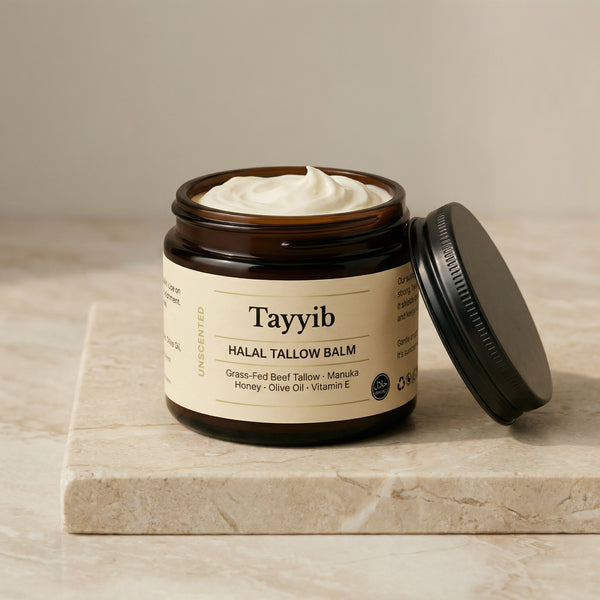
We do not ask you to reason your way through istihala to use our products. Our formulas are halal-certified end to end, which means every derived ingredient in them, glycerin included, has a verified source behind it.
That is the point of a standard. You should be able to pick up a jar and think about your skin, not about supply chains.