Halal skincare is not a shorter list of ingredients. It is a higher standard of knowing where they came from.
That distinction matters, because most of the ingredients people worry about are not forbidden in themselves. They are ambiguous. The same name on a label can describe something from an olive or something from an untraceable abattoir by-product, and the label will not tell you which.
Four questions settle almost every ingredient: is it from an animal, which animal, how was it slaughtered, and was it chemically transformed afterwards. Most contested ingredients are ambiguous rather than forbidden, which is why halal certification of the finished product is the only practical shortcut.
The four questions behind every ingredient
- Is it from an animal? If not, it is almost always straightforward.
- Which animal? Pork is settled. Cattle, sheep and goats depend on the next question.
- How was it slaughtered? This is where most commercial supply chains go dark.
- Was it chemically transformed? This is where istihala enters, and where scholars genuinely differ.
Animal-derived ingredients
| Ingredient | What it depends on | Status |
|---|---|---|
| Tallow | Permissible species, but depends entirely on slaughter and traceability. | Depends |
| Collagen | Marine is fine, porcine is not, bovine depends. | Depends |
| Gelatin | Usually porcine. Also a marker for other by-products. | Avoid |
| Squalane | Now mostly olive or sugarcane, historically shark. | Permissible |
| Lanolin | From sheep wool, no slaughter involved. | Permissible |
| Beeswax, honey | Widely accepted as permissible. | Permissible |
| Carmine, shellac | Insect derived. Scholars differ on external use. | Depends |
| Elastin, keratin | Animal tissue or wool. Source dependent. | Depends |
| Placenta extract | Check carefully. Some versions are plant, some are not. | Depends |
The ambiguous derivatives
These are the ones that slip past almost everybody, because they read as chemistry rather than as animal products.
- Glycerin Plant, animal or synthetic. The clearest case for the istihala discussion. Full guide.
- Stearic acid Plant or animal. Rarely specified.
- Glyceryl stearate Emulsifier, same ambiguity.
- Magnesium stearate Anti-caking agent, same ambiguity.
- Sodium tallowate Saponified tallow, common in bar soap.
- Oleic acid Can come from tallow or from olive and other plant oils.
- Lecithin Usually soy, occasionally egg.
- Allantoin Now almost always synthetic, historically from cattle.
Alcohol
The most misread word on any label, because three unrelated families of ingredient share it. Fatty alcohols such as cetyl alcohol and cetearyl alcohol are waxy moisturisers and are not the issue. Ethanol and alcohol denat. are what the discussion is actually about. Full guide.
Living with prayer
Wudu
Applying skincare after wudu does not invalidate it. The question is whether what is already on your face blocks water next time. Full guide.
Sunscreen
Water-resistant formulas are engineered not to wash off, which is the awkward part. Full guide.
And for the month itself, topical products do not break the fast, but Ramadan is hard on the barrier for three separate reasons. Full guide.
How to read an INCI list
Every cosmetic sold in Australia, the UK, the EU and the US carries the same standardised ingredients list, and it follows rules that make it far more readable once you know them.
- Order means concentration. Ingredients appear from most to least. The first five usually account for the overwhelming majority of the formula.
- Below 1 per cent, order stops mattering. Once concentrations drop under one per cent, a manufacturer may list them in any order. Preservatives, fragrance and colourants are usually clustered at the end, and that cluster marks roughly where the one per cent line sits.
- Latin names mean plant extracts. Olea europaea is olive, Butyrospermum parkii is shea. Plant sources are generally the straightforward ones.
- CI numbers are colourants. CI 75470 is carmine, from insects. Most other CI numbers are synthetic or mineral.
- "Parfum" or "Fragrance" hides a blend. It can legally conceal dozens of components, which is why fragrance-free is the safer choice for reactive skin and for anyone who wants a fully legible label.
Put together, this gives you a fast method: read the first five ingredients to see what the product actually is, then scan the tail for the animal-derived names in the tables above.
Three labels that are not the same thing
| Label | What it rules out | What it misses |
|---|---|---|
| Halal-certified | Impermissible sources, untraceable animal derivatives, cross-contamination in the facility. | Nothing relevant. This is the standard. |
| Certified vegan | Every animal-derived ingredient in one step. | Alcohol. Cross-contamination. Facility standards. |
| "Clean" or "natural" | Nothing. Neither term has a regulatory definition anywhere. | Everything. |
What certification actually buys you
You could work through every item on this page for every product you own. Most people, reasonably, will not.
Halal certification is the shortcut, and it is a real one. It means someone with access to the supply chain has verified the source of every derived ingredient, checked that halal material was not blended with unverified material downstream, and audited the facility.
It is the difference between a brand that says "suitable for Muslims" and a brand that can prove it.
How to check a certification is real
Certification is only worth what the certifier is worth, and the logos are easy to imitate. Three checks take about a minute.
- Look for a named body, not a generic crescent. A real certificate names the organisation that issued it.
- Check what is covered. Certification can apply to one ingredient, one product or an entire facility. A brand certifying a single raw material and implying the whole range is covered is the most common sleight of hand.
- Check the date. Certificates expire, because suppliers change. An undated certificate is not evidence of anything current.
- "Halal-friendly" is not certification.
- "No haram ingredients" is a claim, not an audit.
- "Muslim-owned" describes the company, not the formula.
The rest of the bathroom
Skincare gets the attention, but the same derivatives turn up on every other shelf, and some of them are harder to spot.
- Toothpaste Glycerin is a main ingredient in most formulas, and it is swallowed in trace amounts, so some treat it more strictly than a topical. Some brands also use bone-derived calcium phosphate.
- Shampoo and conditioner Keratin, silk amino acids, and cationic conditioning agents derived from animal fats. Panthenol is synthetic and fine.
- Deodorant Stearic acid and stearyl alcohol are common in solid sticks. Many aerosols and sprays are alcohol based.
- Lip balm Beeswax is widely accepted. Lanolin is common and generally uncontroversial. Carmine appears in tinted versions.
- Nail polish Rarely an ingredients question, almost always a wudu question.
- Makeup Carmine in anything red or pink, and lanolin in cream formulas. Long-wear and waterproof versions raise the wudu question too.
The same three routes apply: learn the handful of names that recur, use vegan certification as a fast filter for the animal-derived ones, or buy certified.
What to do with what you already own
A reasonable, non-paralysing approach for the products already in your bathroom.
- Start with what stays on your skin. Moisturisers, balms and sunscreens matter more than a cleanser you rinse off in thirty seconds.
- Check the top five ingredients first. Concentration is ordered, so the things present in meaningful amounts are at the top.
- Email the brand about anything ambiguous. Ask specifically whether an ingredient is plant, synthetic or animal derived, and which supplier it comes from.
- Replace gradually as things run out. There is no obligation to throw out a cupboard, and doing so is more likely to end in giving up than in a better routine.
Where Tayyib Skincare stands
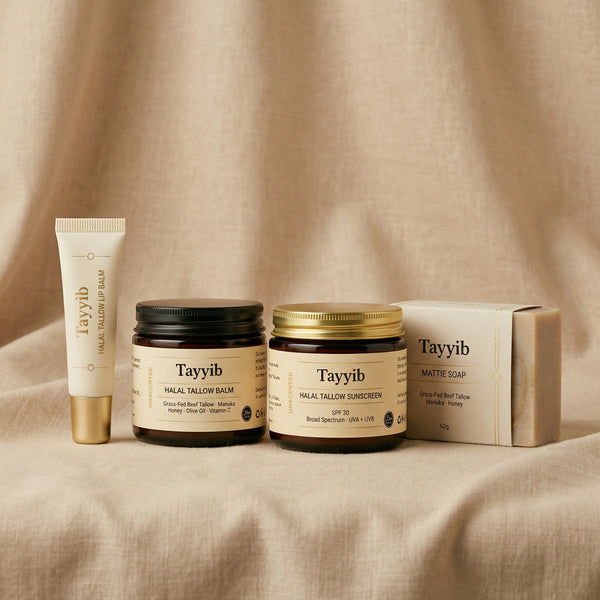
We built Tayyib Skincare so this page would not have to be your problem. Every product is halal-certified, alcohol-free, seed-oil free, and made from a tallow source we can trace.
That standard is not a limitation we work around. Insisting on traceability produces better formulas, because the shortcuts we are refusing are the cheap ones.
Muslim women who decided that was worth choosing deliberately