Gelatin is the ingredient most Muslim consumers already check for in food. Fewer people think to check for it in skincare.
It turns up in peel-off masks, sheet masks, hair products, capsules and some creams as a film former and thickener.
Most cosmetic gelatin is porcine, which is not permissible. Bovine gelatin depends on the slaughter method and is rarely traceable. Fish gelatin is permissible by the majority position but uncommon in cosmetics. Gelatin is also a useful marker: a formula reaching for cheap animal by-product in one place often does so elsewhere.
Where gelatin comes from
Gelatin is made by breaking down collagen from animal skin, bone and connective tissue. In practice that means pigs or cattle, and porcine gelatin dominates global supply because pig skin is an abundant and cheap raw material.
Bovine gelatin depends on the slaughter, and as with tallow and collagen, industrial by-product supply chains rarely carry that information.
Where you will actually meet it
- Peel-off masks The classic use. Gelatin is what makes the film peel away in one sheet.
- Sheet masks Sometimes used in the essence as a thickener.
- Capsules and supplements Softgel shells are very often porcine gelatin.
- Hair products Used in some strengthening and volumising treatments.
- Creams Occasionally, as a texture agent.
The ingredients that travel with it
- Stearic acid Fatty acid, animal or plant. Very common, almost never specified.
- Glyceryl stearate Emulsifier, same ambiguity.
- Magnesium stearate Anti-caking agent, same ambiguity.
- Sodium tallowate Saponified tallow. Common in bar soap.
- Lanolin From sheep wool, taken without slaughter. Generally uncontroversial.
- Keratin Usually wool, feathers or horn. Source dependent.
- Carmine, CI 75470 Crushed insects, used for red pigment. Scholars differ.
- Shellac An insect resin. Same discussion as carmine.
- Elastin Animal connective tissue. Same questions as collagen.
On insect-derived ingredients such as carmine and shellac, a number of scholars permit external use while others avoid them. The discussion differs from the one about ingestion.
Vegan is not the same as halal
This trips people up constantly, and it cuts both ways.
What vegan does cover
Every animal-derived ingredient on this page. If a product is genuinely certified vegan, gelatin, tallow, carmine, lanolin and collagen are all ruled out in one step. As a filter it is efficient.
What vegan does not cover
Alcohol. A vegan product can be built on alcohol denat., and many are. It also says nothing about cross-contamination or facility standards.
The reverse is also true: halal does not imply vegan. Tallow and lanolin are animal derived and permissible when properly sourced. The two standards overlap without containing each other.
The realistic way to handle this
You cannot audit every ingredient in every product you own. Nobody can. There are three practical routes, in increasing order of certainty.
- Learn the markers. The box above covers most of what you will actually meet. Recognising eight or nine names gets you a long way.
- Use vegan certification as a filter. It is not the same as halal, and it says nothing about alcohol, but it reliably rules out every animal-derived ingredient on this page in one step.
- Buy halal-certified. Certification exists precisely so this work is done once, properly, by someone with access to the supply chain, instead of by you in a shop aisle.
How to ask a brand, and get a real answer
Vague questions get vague answers. Send something a customer service inbox cannot deflect with a template:
"Is the gelatin in this product porcine, bovine or fish derived? If bovine, is it from a halal-certified supplier, and can you name the certifier?"
The tell is the response time. A brand with documentation answers in a day. A brand that goes quiet, or replies only that it has "no pork ingredients", has told you that nobody has checked.
Supplements are the same question, stricter
Worth flagging because the two shelves sit next to each other and the reasoning differs. Softgel capsules, collagen powders, gummy vitamins and vitamin E capsules all commonly use porcine gelatin.
Because a supplement is swallowed rather than applied, the sourcing question is treated more strictly, and the istihala arguments that soften the ruling on a saponified derivative do not apply to gelatin, which is not chemically transformed into something else. Look for fish gelatin, plant-based capsules such as HPMC, or explicit halal certification.
Where Tayyib Skincare stands
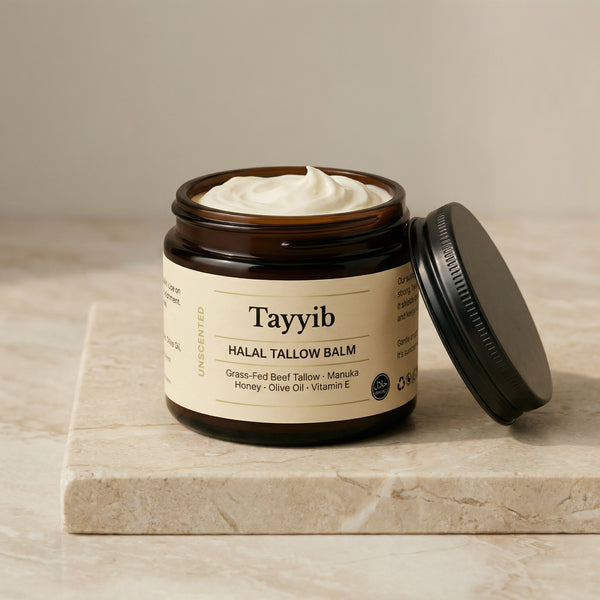
There is no gelatin, no carmine and no unverified animal derivative in anything we make. The one animal ingredient we use is tallow, and it is the ingredient we are most transparent about, because a traceable, halal-certified source is the whole reason the brand exists.