Every year the same thing happens around the second week. Skin gets tight, dull, flaky at the edges, and breaks out in places it usually does not.
It is not imagination, and it is not a sign you are doing Ramadan wrong. Three things change at once during the month, and each of them shows up on your face.
Topical products do not break the fast, because nothing enters the body cavity. The skin changes people notice in Ramadan come from fluid intake compressed into a shorter window, more frequent wudu stripping barrier lipids, and broken sleep reducing overnight repair. Simplify the routine rather than adding to it, and apply a balm to damp skin after wudu.
What actually changes
Less water, over a compressed window
You are still drinking, but between Maghrib and Fajr. Mild dehydration shows first in skin, which the body deprioritises when water is short.
More wudu, more washing
Extra prayers mean extra wudu. Each wash removes lipids from the barrier as the water evaporates, and over a month this compounds.
Add to that the third factor: waking for suhoor breaks the deep sleep window when skin does most of its repair. Less repair means more visible inflammation and slower healing of anything already going on. See our full guide to wudu and skincare for the barrier detail.
A routine for the month
Suhoor
- Drink water steadily through the evening rather than a litre at once. The body excretes what it cannot use.
- Eat something with fat and protein. Skin is built from lipids, and a suhoor of only fast carbohydrates leaves you dull by Asr.
- Apply a balm on damp skin after Fajr wudu. This is the highest-value thing in the whole routine.
During the day
- Do less, not more. A tired barrier is not the time to start a new active.
- Keep wearing SPF. Fasting does not pause UV.
- Reapply balm to tight spots after wudu rather than waiting for the evening.
- Skip harsh foaming cleansers. You are already washing five or more times.
- Do not start retinoids or acids this month.
After iftar
- Cleanse properly once, at night. That is enough.
- This is the window for a heavier occlusive layer, since you are not making wudu again until Fajr.
- Go gently on the fried food and sugar. Both show up on skin within about forty-eight hours for most people.
Week by week
The month is not uniform, and the problems arrive in a fairly predictable order.
| When | What usually shows up | What to do |
|---|---|---|
| Week 1 | Headaches, dullness, mild dehydration as the body adjusts. | Focus on evening fluid intake. Do not change your routine yet. |
| Week 2 | Tightness and flaking. The barrier damage from extra wudu compounds. | Add the post-wudu balm step if you have not. Drop any actives. |
| Week 3 | Breakouts, often along the jaw, from iftar food and disrupted sleep. | Do not start treating aggressively. Keep cleansing gentle and once daily. |
| Last 10 nights | Real sleep deprivation. Everything looks worse. | Simplify to cleanse, balm, SPF. Protect rather than correct. |
| Eid | Wanting skin to look its best at short notice. | Nothing new in the last week. A new product now is a gamble. |
Does skincare break your fast?
The majority position is that applying something to the skin does not break the fast, because nothing enters the body cavity. Moisturiser, sunscreen and cleanser are all fine during fasting hours.
Care is usually advised with anything that could reach the throat, such as lip products that get licked, or strongly scented oils near the nose. As always, if you want a ruling to act on, put it to your local scholar.
Hijab, heat and the skin underneath
If Ramadan falls in summer, and in Australia it increasingly does, there is a second problem stacked on top of the fasting one.
Fabric plus heat plus sweat, with no chance to rinse during daylight, creates friction and trapped moisture along the hairline, forehead and jaw. That is the classic pattern behind hijab-related breakouts, and it is mechanical rather than dietary. Treating it as ordinary acne with strong actives usually makes it worse, because the barrier is already compromised.
- Choose breathable natural fabrics over synthetics in the heat.
- Carry a spare undercap and change it if it gets damp. This is the single most effective change.
- Keep the hairline in the wudu wash. It is the area most often skipped.
- Do not add an exfoliant to fix friction damage.
If you are travelling for Umrah
Different climate, long flights, very dry cabin air and far more sun exposure than usual, all at once. Pack the barrier products rather than the treatment ones, keep SPF in hand luggage, and expect the first three days to be the worst as skin adjusts to the humidity change.
Where Tayyib Skincare stands
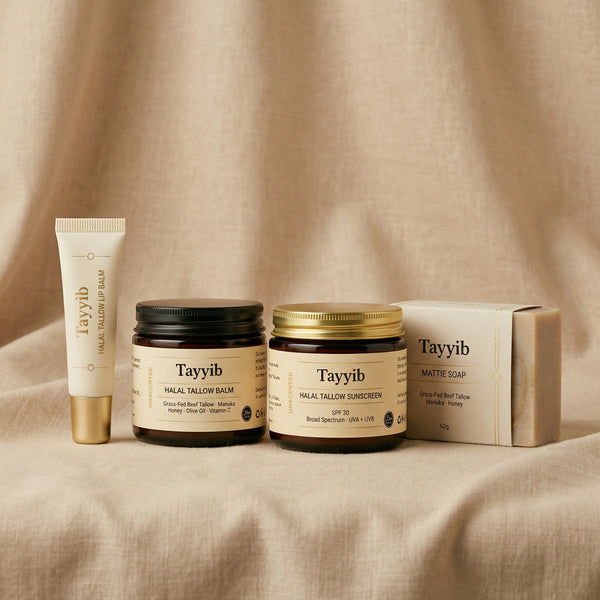
Our Complete Skincare Routine is built around this rhythm: cleanse once, restore the barrier after wudu, protect through the day. Everything in it is halal-certified, alcohol-free and fragrance-free, so it works on skin that is already being asked to do a lot.
Ramadan is not the month to overhaul your skin. It is the month to protect what you have and keep it simple.