Squalane has become one of the most recommended ingredients for dry and sensitive skin. It is light, non-comedogenic, extremely well tolerated, and it mimics a lipid our own skin already makes.
It also has an origin story that catches people off guard.
Olive-derived and sugarcane-derived squalane are plant-based and permissible. Shark-derived squalane is permissible under most schools, which treat sea creatures as halal, though the Hanafi position is narrower. Most quality cosmetic squalane today is plant-derived, but the INCI list says only "Squalane" either way, so you have to read the packaging copy.
Squalene, squalane, and the shark
Your skin naturally produces squalene, with an "e". It is part of sebum, and it drops off sharply with age, which is part of why skin gets drier over time.
Squalene is unstable and oxidises quickly, so cosmetic chemists hydrogenate it into squalane, with an "a", which is shelf-stable and does not go rancid.
Historically the raw squalene came from shark liver oil, which is exceptionally rich in it. That is still true of some cheap supply, mostly in supplements and lower-cost cosmetics.
The ruling on the shark version
For most schools of thought, sea creatures are permissible and do not require ritual slaughter, which would make shark-derived squalane permissible. The Hanafi position is narrower, holding that among sea creatures only fish are permissible, which raises a question about whether a given shark species falls inside that.
There is genuine discussion here between the schools, and it turns on a definitional question about what counts as fish rather than on the ingredient itself.
Beyond fiqh, shark-derived squalane carries a serious conservation problem. Several deep-sea shark species are under real pressure from liver-oil harvesting.
For a faith that treats stewardship of creation as a responsibility, that is not a side issue.
The good news
Most reputable cosmetic squalane today is olive-derived, made from the squalene naturally present in olive oil, or sugarcane-derived, produced by fermentation. Both are entirely plant-based and avoid the question completely.
Brands using plant squalane almost always say so on the packaging, because it costs more and it is a selling point. That gives you a useful heuristic.
How to check
- Look for olive-derived squalane, plant-derived squalane or sugarcane-derived squalane in the copy.
- A certified vegan product rules out the shark version.
- On an INCI list both read simply as Squalane. The ingredients list cannot answer this for you.
- Silence on the source, especially in a very cheap product, is worth a question.
What squalane is good for
Since you may be deciding whether you need it at all.
What it does well
Absorbs almost instantly with no greasy finish, does not clog pores, and is one of the least irritating oils available. Good for oily and acne-prone skin that still needs lipids.
What it does not do
It is an emollient, not an occlusive. It softens and smooths but it does not seal the barrier the way a balm does, so very dry skin usually needs something heavier over the top.
How to layer it
Squalane goes on after water-based steps and before anything heavier. On damp skin it works better. If your skin is very dry, treat it as a middle layer rather than the final one.
Why the hydrogenation matters more than people realise
It is easy to read "squalane is the stable version" as a technicality. It is not.
Squalene, the unstable form, oxidises readily on skin, and oxidised squalene is associated with clogged pores and inflammation. It is one of the reasons pure oils high in unstable fats can make acne-prone skin worse over time. Hydrogenating it into squalane removes that failure mode entirely, which is why squalane suits acne-prone skin while several richer plant oils do not.
Practical upshot: squalane keeps well and does not need refrigerating or rushing. A bottle will not turn on you the way a cold-pressed seed oil can.
Where Tayyib Skincare stands
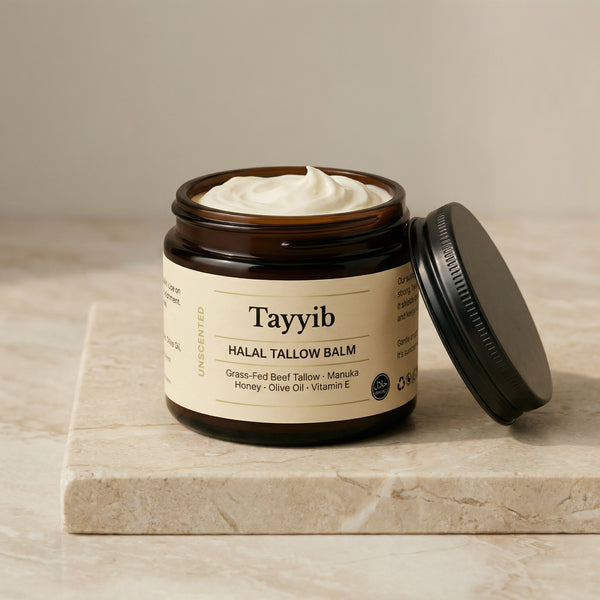
We take a simpler route to the same result. Tallow already carries a fatty acid profile close to human sebum, which is the property squalane is prized for, and it seals as well as softens. Halal-certified and traceable, it does both jobs without needing a shark or a supply chain audit.