If you pray five times a day and you care about your skin, you have had this thought halfway through a routine: am I about to undo my wudu?
The rule is simpler than the anxiety around it.
Wudu requires water to reach the skin during the washing itself. Applying skincare after wudu does not invalidate it. The only thing to consider is whether a product already on your face forms a water-impermeable barrier when you go to make wudu next time. Products that absorb are generally not treated as a barrier. Nail polish and waterproof products are.
What counts as a barrier
Generally not a barrier
- Serums and essences that absorb fully
- Lightweight moisturisers and lotions
- Balms and oils massaged in and absorbed
- Toners
Generally a barrier
- Nail polish, the classic example
- Waterproof or long-wear makeup
- Water-resistant sunscreen
- Heavy occlusive layers left sitting on top
- Plasters, false lashes, lash glue
Opinions vary on where exactly the line sits for products that only partially absorb, and on whether a thin film water can still penetrate counts as a barrier at all. For a specific product you are unsure about, ask a scholar rather than a brand. What follows is practical, not a ruling.
Makeup, specifically
This is where most of the real-world questions come from, so it is worth being precise about which parts matter.
- Foundation and concealer Ordinary formulas wash off with water and are not usually treated as a barrier. Long-wear and transfer-proof versions are designed not to, and need removing.
- Waterproof mascara The most commonly raised item, and the hardest to remove. Regular mascara is a much easier choice if you pray during the day.
- Nail polish The classic barrier. Conventional polish must come off.
- "Breathable" polish Marketed as water-permeable. Scholars differ on whether the permeability is sufficient.
- Lip products Generally not an issue for wudu, since lips are rinsed rather than washed, but heavy long-wear formulas are worth removing.
A routine that works around five prayers
- Cleanse and make wudu first. Let the water do its job on bare skin. This is also simply better for your skin than layering over a day of grime.
- Apply while skin is still damp. Damp skin holds product far better and you will need noticeably less of it.
- Choose things that absorb. A balm that melts into the barrier behaves very differently from one that sits on the surface as a film.
- Save heavy occlusives for night, after Isha, when you are not making wudu again until Fajr.
- Keep nails bare, or use a breathable polish and know that opinions differ on those too.
Mapped to the day
| When | What to do | Why |
|---|---|---|
| Fajr | Wudu, then balm on damp skin, then SPF once it is light. | The longest gap in the day. Product has time to absorb properly. |
| Dhuhr | Wudu, reapply SPF. | Washing has already removed most of the morning layer. |
| Asr | Wudu, spot-apply balm anywhere tight. | The point in the day when dryness usually shows up. |
| Maghrib | Wudu only. | Leave the skin alone; the evening cleanse is coming. |
| Isha | Cleanse properly, then the heavier night layer. | No wudu until Fajr, so occlusives are free to work overnight. |
The problem nobody warns you about
Making wudu five times a day means washing your face with water five times a day. For dry or sensitive skin, that is a lot.
Water alone strips lipids from the skin barrier as it evaporates. This is why so many Muslim women describe a tight, papery feeling after wudu that no amount of drinking water fixes. It is not dehydration from the inside. It is barrier damage from the outside.
This is not a reason to do less wudu. It is a reason to replace what the water takes.
Three things that make wudu gentler on skin
- Use lukewarm water, not hot. Hot water strips lipids far faster and leaves skin flushed.
- Pat, do not rub. A rough towel does more damage than the water did.
- Apply within a minute, while damp. The window where damp skin will take up product is short.
The situations people actually ask about
"I realised mid-prayer that I still had makeup on"
Finish your prayer. Scholars generally treat an honest mistake differently from a deliberate omission, and the question of whether to repeat the wudu and prayer is exactly the kind of specific ruling to put to your scholar rather than to a search engine.
"Does this apply to ghusl too?"
The same principle, more strictly, because ghusl requires water over the whole body. Anything forming a genuine barrier anywhere needs removing first, which is the usual reason nail polish comes up in this context.
Two more that come up often. Beard oil behaves like any absorbed facial oil and is not generally treated as a barrier. Henna stains the skin rather than coating it, and staining is widely held not to prevent water reaching the skin, which is why it is treated differently from nail polish.
Where Tayyib Skincare stands
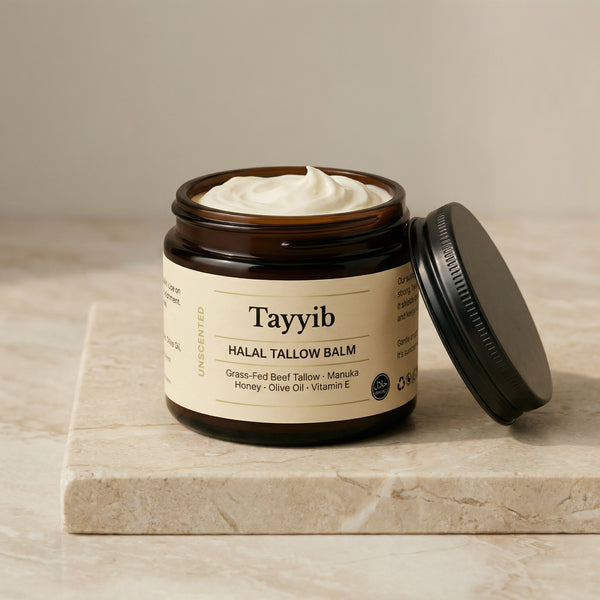
Our Halal Tallow Balm was made for this rhythm. Tallow is structurally close to the skin's own oils, so it absorbs into the barrier rather than sitting on the surface as a film, and it goes on best on the damp skin you have right after wudu. Alcohol-free, fragrance-free, halal-certified.
See also our guide to sunscreen and prayer, which is the one product where the barrier question genuinely bites.