Sunscreen is the one product dermatologists agree on, and the one that causes the most confusion for anyone praying five times a day.
It is meant to stay put. Wudu is meant to reach the skin. Those two facts pull against each other, and most advice online resolves the tension by quietly suggesting you skip the SPF. That is the wrong answer.
Sunscreen applied after wudu does not invalidate it. The issue is water-resistant sunscreen still on your face at the next wudu, because it is engineered to repel water. Use a non-water-resistant formula for everyday wear, apply it after your morning wudu, and reapply after a later wudu rather than layering.
Two separate questions
People collapse these together, and they have different answers.
Is the SPF halal?
An ingredients question. Sunscreen filters themselves are fine. The things worth checking are the carriers and additives around them.
Does it interfere with wudu?
A physical question about whether water reaches your skin. It applies to any product, however halal its ingredients are.
Ingredients worth checking in an SPF
- Alcohol denat. Very common in lightweight sunscreens. See our guide to alcohol.
- Collagen Usually bovine or porcine. See is collagen halal.
- Glycerin Plant, animal or synthetic. See is glycerin halal.
- Squalane Once shark-derived, now usually olive. See is squalane halal.
- Stearic acid Animal or plant. Rarely specified.
Mineral or chemical?
Mineral filters, zinc oxide and titanium dioxide, sit on the surface and reflect light. Chemical filters absorb into the upper layers and convert UV to heat. Neither is inherently more or less halal, and both are permissible in themselves.
For wudu, the practical difference is smaller than people expect. A well formulated mineral sunscreen rubbed in properly is not a sealed waterproof film.
The factor that matters is the water-resistance rating, not the filter type.
The water-resistance problem
A sunscreen labelled 40 or 80 minutes water-resistant contains film formers whose entire job is to survive water. That is genuinely useful at the beach and genuinely awkward before wudu. If water beads and rolls off your face, it is not reaching the skin underneath.
Scholars differ on how much of a film is enough to matter, and a thin absorbed layer is treated differently from a heavy waterproof one. For a personal ruling, ask your scholar.
How much to actually apply
Almost nobody applies enough, which means almost nobody gets the SPF on the bottle. The tested amount is roughly a quarter teaspoon for the face alone.
- The two-finger rule. A line of product along your index and middle finger, first knuckle to tip, is about right for a face.
- Do not forget the edges. Hairline, ears, jaw, and the front of the neck.
- If you wear hijab, your face is still exposed and it is the area that shows sun damage first. Covering the head does not protect the face.
The vitamin D question
This comes up often and deserves a straight answer. If you cover and you also wear daily SPF, your skin is making very little vitamin D, and that is a genuine concern rather than a myth. The answer is not to skip sun protection, because the sun exposure needed for meaningful synthesis also causes the damage. The answer is to get your levels tested and supplement if they are low, which is what most clinicians recommend for anyone who covers.
A routine that works
- Make wudu, then apply. Fajr or Dhuhr wudu, then SPF, covers the brightest part of the day.
- Reapply after the next wudu, not on top of the old layer. Washing for wudu conveniently removes most non-water-resistant SPF, so reapplication happens naturally.
- Skip water-resistant formulas for everyday wear. Save them for swimming and long days outdoors, and wash properly before wudu.
- Do not skip SPF to avoid the question. Sun damage is cumulative, and it is the main driver of the uneven tone and dark spots people then spend years trying to correct.
When you cannot wash between prayers
Reapplying properly means starting from clean skin, and that is not always possible. At work, travelling, or out for the day, wudu happens but a full cleanse does not.
- Reapplying over a wudu-damp face is fine. It is not ideal, but a second layer of SPF beats no second layer.
- A stick or compact SPF is easier to layer over existing product than a lotion.
- If you genuinely cannot reapply, seek shade in the middle of the day. Behaviour is a legitimate part of sun protection, not a fallback.
Three myths worth clearing up
- "SPF 50 is twice SPF 30." SPF 30 blocks about 97 per cent of UVB, SPF 50 about 98. The gap is far smaller than the number suggests. How much you apply matters more than which number you buy.
- "Darker skin does not need sunscreen." More melanin is genuinely more protective, but not enough to prevent damage, and hyperpigmentation, which is the complaint we hear most, is driven directly by UV.
- "Makeup with SPF is enough." Only if you apply the tested amount, which for foundation would be far more than anyone wears. Treat it as a bonus, not the layer.
Where Tayyib Skincare stands
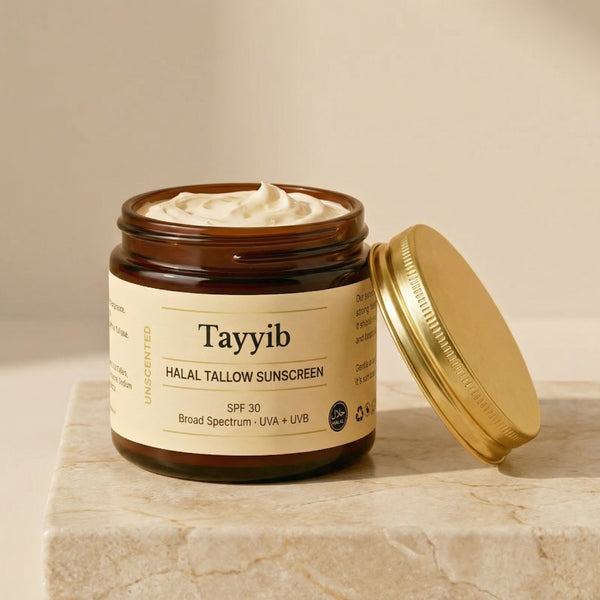
Our Halal Tallow Sunscreen SPF30 was formulated for exactly this routine. Halal-certified, alcohol-free and seed-oil free, built on the same tallow base as the rest of the range so it nourishes while it protects rather than sitting on the skin like a mask. Made for daily wear between prayers, not for a day at the beach.