This is the single most misread word on a skincare label. Two products can both list "alcohol" and be completely different things.
One is a volatile solvent related to what makes wine intoxicating. The other is a waxy moisturising ingredient made from coconut. Knowing which is which will stop you avoiding perfectly good products, and stop you buying ones that are quietly wrecking your skin barrier.
Fatty alcohols such as cetyl, stearyl and cetearyl alcohol are waxy, non-intoxicating moisturising ingredients and are not the subject of the discussion. Ethanol, listed as alcohol denat. or SD alcohol, is the one scholars discuss, and opinions genuinely differ on external use. It is also drying and damaging to a compromised skin barrier regardless of the ruling.
Three families, one word
| On the label | What it is | Status |
|---|---|---|
| Alcohol denat. SD alcohol Ethanol | Volatile solvent. Evaporates fast, makes a product feel light. Same molecule found in intoxicants. | Depends |
| Cetyl alcohol Cetearyl alcohol Stearyl alcohol | Waxy solids from coconut or palm. Not volatile, not intoxicating. Soften skin and hold emulsions together. | Permissible |
| Benzyl alcohol Phenoxyethanol | Preservatives, not intoxicants. Sometimes avoided for sensitivity, not for religious reasons. | Permissible |
The naming overlap is an accident of chemistry. A fatty alcohol shares a hydroxyl group with ethanol and nothing else that matters here.
Why brands put ethanol in at all
It is worth understanding the motive, because it tells you which product categories to check first.
- It makes things feel weightless. Ethanol flashes off in seconds, which is how a lightweight gel or an "invisible" sunscreen achieves that finish.
- It helps other ingredients penetrate. As a solvent it carries actives into the upper layers faster.
- It is self-preserving at high percentages, which lets a brand claim to be free of conventional preservatives.
- It is cheap and it dissolves things that water will not.
Where it hides
If you are checking a shelf, start with these. They are the categories where ethanol appears most often and highest in the list.
- Toners and essences The classic home of alcohol denat., especially anything marketed for oily skin.
- Lightweight sunscreens Particularly "invisible" or "watery" finishes. See halal sunscreen.
- Setting sprays Almost always alcohol-based.
- Astringents and spot treatments Ethanol does the drying, which is the point.
- Fragranced anything Perfume oils need a solvent to carry them.
What scholars actually say about ethanol on skin
There is a genuine range of opinion, and it is worth knowing its shape rather than a single soundbite.
- By source. Ethanol produced from grapes or dates, the classical khamr sources, is treated more strictly than synthetic or grain ethanol, which many scholars regard as permissible for external use.
- By purpose and quantity. Small amounts used as a solvent or preservative, with no intoxicating effect, are permitted on this view.
- Avoidance. A stricter position avoids topical ethanol entirely, partly because of the residue question before wudu.
These are real differences among qualified scholars, not a case of some people being careless. We are not going to pick one for you. If you want a ruling to act on, ask a scholar you trust.
The part nobody argues about
Whatever position you hold, high concentrations of denatured alcohol are bad for a compromised skin barrier. It strips lipids, increases water loss, and produces that tight squeaky feeling people mistake for cleanliness.
If your skin is dry, reactive or eczema-prone, ethanol high in the ingredients list is working against you regardless of the fiqh.
There is a second-order problem too. Ethanol-heavy products often feel like they are working, because oil disappears immediately. Skin then compensates by producing more oil, which reads as confirmation that you needed the product. That loop is why so many people with oily skin end up with dehydrated skin underneath.
How to check a bottle in ten seconds
- Find the ingredients list and read the first five entries. Position matters. Ingredients are listed by descending concentration.
- If you see alcohol denat. in that top five, the product is mostly solvent. That is the one to think about.
- If the only match is cetyl, cetearyl or stearyl alcohol, there is nothing to consider. Those are moisturisers.
- If the label just says alcohol with no qualifier, treat it as ethanol and ask the brand.
What to use instead
If you are removing an ethanol-heavy step, do not simply delete it. Replace the job it was doing.
Instead of an astringent toner
A hydrating toner or nothing at all. Most people do not need a toner; the step exists largely for historical reasons.
Instead of a quick-dry finish
A balm applied thinly to damp skin. It takes longer to sink in but it does not cost you barrier lipids to get there.
What about perfume and attar?
This comes up immediately after the skincare question, and the answer is not automatically the same.
Conventional perfume is mostly ethanol, typically 70 to 90 per cent, because alcohol is what carries and projects the scent. That puts it squarely inside the discussion above, and it is why so many Muslim households use attar instead: concentrated fragrance oil in a carrier oil, with no alcohol at all.
The practical difference is worth knowing. Attar sits close to the skin and lasts a long time without projecting far. Alcohol-based perfume projects immediately and fades faster. Neither is better as a fragrance; they behave differently.
The same range of opinion applies here as to skincare, with the added point that perfume is applied deliberately and left on. Some who permit trace ethanol in a formula still avoid alcohol-based perfume for that reason. Your scholar is the right person to ask.
One thing to check either way
If you wear fragrance and you pray, be aware that a heavy oil-based attar sits on the skin as a film. It is unlikely to be treated as a wudu barrier in the way nail polish is, but it is worth applying to clothing or to points that are not washed in wudu if you want to avoid the question entirely.
Where Tayyib Skincare stands
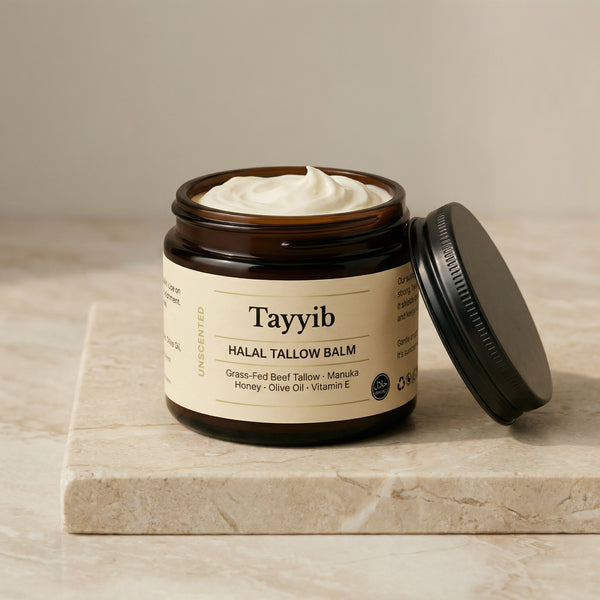
Every Tayyib Skincare product is alcohol-free in the sense that matters: no ethanol, no alcohol denat., no isopropyl alcohol. We chose that deliberately, because our customers have dry and sensitive skin and because we would rather remove the question than explain it away.
This is the quiet advantage of holding a stricter standard. Refusing an ingredient tends to produce a gentler formula, not a lesser one.