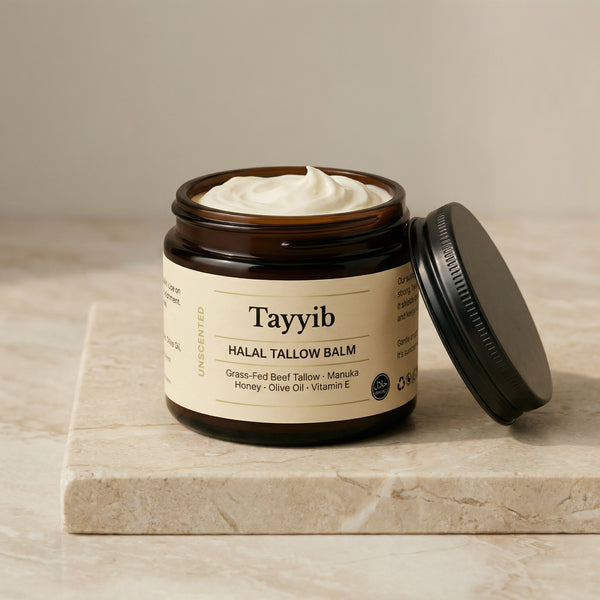
Tallow has gone from a forgotten kitchen fat to one of the most talked about ingredients in skincare. The question that follows it into every Muslim household is always the same one.
Is beef tallow halal? And how would you even know?
Beef tallow is halal only when it comes from a permissible species, that animal was slaughtered according to Islamic requirements, and the fat was kept separate from unverified sources afterwards. Most commercial tallow fails the second test, because it is an industrial meat by-product with no slaughter traceability. Certification is the only practical way to confirm all three.
What tallow actually is
Tallow is rendered fat, usually from cattle. The fat is gently heated until it separates from the tissue, then filtered and cooled into a firm, creamy solid.
The reason it works so well on skin is not marketing. Tallow is structurally close to sebum, the oil our own skin produces, which is why it melts in rather than sitting on top.
What is in it
Palmitic, stearic and oleic acids in roughly the same proportions as human sebum, plus the fat-soluble vitamins A, D, E and K.
Why that matters
A barrier rebuilds itself from lipids it recognises. Tallow supplies them directly instead of asking the skin to absorb something unfamiliar.
The three questions that decide the ruling
Whether a given batch of tallow is halal comes down to three things, in order. Almost every product on the market passes the first and fails the second.
- What animal did it come from? Cattle, sheep and goats are permissible species. Pork is not. Note that lard is the correct term for rendered pork fat while tallow conventionally means beef or mutton, but a label reading only "animal fat" tells you nothing.
- How was the animal slaughtered? This is where nearly all commercial tallow falls down. Tallow is collected in enormous volumes from abattoirs that do not separate zabiha animals from the rest, then blended and rendered before it reaches a cosmetics factory. Nobody in the chain can tell you how those animals died.
- Was it kept separate afterwards? Halal-rendered tallow processed on shared equipment, or cut with cheaper unverified fat to hold a price, does not stay halal. Certification covers the whole chain, not just the first step.
Silence on a label is not reassurance. It usually means the question was never asked.
What certification actually checks
"Halal-certified" is not a sticker a brand buys. A credible certifier works backwards from the finished jar, and the audit covers more than the headline ingredient.
- The abattoir, and whether slaughter met Islamic requirements.
- The rendering plant, and whether halal batches were segregated from conventional ones.
- Every other derived ingredient in the formula, including glycerin and emulsifiers.
- The filling facility, and whether shared equipment is cleaned between runs.
- Ongoing re-audit, because a supplier can change without the brand noticing.
That last point is the one people miss. Certification is a continuing relationship rather than a one-off test, which is why a certificate has a date on it.
The istihala question
You may have read that chemical transformation, istihala, can change the ruling on a derived ingredient. This is a real and well established discussion. Many scholars hold that when a substance is genuinely transformed into something different, it takes on a new ruling. It is the reasoning often applied to soap, where fat is saponified into something that is no longer fat.
That argument does not transfer to a tallow balm. Rendering is purification, not transformation. The fat in the jar is still fat, unchanged at the molecular level, so the source remains the deciding factor.
Scholars differ on the boundaries of istihala, particularly for ingredients that sit between purification and true chemical change. If you want a position you can rely on personally, that is a conversation for your local scholar rather than a brand.
How to read a label
These are the terms that actually appear on packaging, and what each one does and does not tell you.
- Tallow Rendered beef or mutton fat. Species is likely fine. Says nothing about slaughter.
- Sodium tallowate Saponified tallow, common in bar soap. Source unstated unless the brand says so.
- Stearic acid Can be animal or plant derived. Almost never specified.
- Glyceryl stearate Same ambiguity. An emulsifier, extremely common.
- Animal fat Deliberately vague. Assume nothing.
Claims that sound like answers but are not
- "Grass-fed" is a claim about diet. It says nothing about slaughter.
- "Halal-friendly" and "suitable for Muslims" are marketing phrases with no standard behind them.
- "Muslim-owned" describes who owns the company, not what is in the jar.
- "All natural" has no regulatory meaning in cosmetics anywhere.
What actually confirms it
- Halal certification from a recognised body, covering the finished product.
- A brand that can name its rendering source when you ask.
- A stated, traceable supply chain rather than a commodity purchase.
How tallow compares to what you are using now
Worth knowing what you are actually choosing between, because tallow is not the only barrier-supporting option and it is not right for everyone.
| Ingredient | How it behaves | Halal status |
|---|---|---|
| Tallow | Closest match to sebum. Occlusive and nourishing. Carries vitamins A, D, E and K. | Depends |
| Shea butter | Plant occlusive, heavier, can feel waxy. Fine for most skin. | Permissible |
| Jojoba | Technically a wax ester, also sebum-like. Lighter than tallow. | Permissible |
| Squalane | Very light, absorbs fast. Now usually olive-derived. | Permissible |
| Petrolatum | Pure occlusive. Seals but feeds the barrier nothing. | Permissible |
Tallow earns its place because it does two jobs at once: it seals like an occlusive and it supplies lipids the barrier can actually use. Most alternatives do one or the other.
The two objections we hear most
"Won't it clog my pores?"
Tallow sits low on the comedogenicity scale, but this genuinely varies by person. If you are acne-prone, patch test along the jaw for a week before using it across the face. Oily skin often does better with a thin layer at night only.
"Won't it smell like beef?"
Properly rendered and refined tallow has no meaty smell at all. If a tallow product smells of anything other than what has been deliberately added, it was under-refined.
Who tallow suits, and who it does not
- Dry, dehydrated or flaky skin.
- Sensitive and reactive skin, particularly if fragrance is a trigger.
- Eczema-prone skin and post-wudu tightness.
- Mature skin where natural lipid production has dropped.
- Actively inflamed, cystic acne. Speak to a dermatologist first.
- Anyone who prefers a completely plant-based routine, for whom olive squalane is the better answer.
How to actually use a tallow balm
Tallow is used differently from a lotion, and most disappointment with it comes from applying it like one. It is concentrated, so a little genuinely does go a long way.
- Take less than you think. A pea-sized amount covers a whole face. Too much is the usual reason people find it heavy.
- Warm it between your fingers first. Tallow is solid at room temperature and melts at body heat. Warming it turns it into an oil that spreads easily.
- Press it into damp skin, do not rub. Straight after cleansing or wudu, while there is still water on the surface. Pressing traps that water underneath.
- Give it two minutes. It looks greasy at first and then it does not. Judge it after it has settled, not immediately.
- Use it as the last step. Anything water-based goes on before, never after.
Why we leave the seed oils out
You will notice tallow products from serious brands tend to avoid sunflower, safflower, grapeseed and rapeseed oil. That is a formulation choice worth understanding rather than a slogan.
Seed oils are high in polyunsaturated fats, which are chemically unstable. They oxidise on contact with air, light and heat, and an oxidised oil on the skin is pro-inflammatory rather than soothing. They also go rancid faster, which is why products built on them lean harder on preservatives and fragrance.
Tallow is mostly saturated and monounsaturated fat. It is stable, it keeps without a heavy preservative load, and it does not need a scent covering anything.
Where Tayyib Skincare stands
We built Tayyib Skincare around this exact gap. Our tallow is halal-certified and halal-rendered, traced from a verified source rather than bought on the open by-product market, and refined so there is no animal scent to mask with fragrance. No alcohol, no seed oils.
Choosing halal here is not a compromise on quality. Insisting on a traceable chain gets you a cleaner, better made fat than the commodity alternative. That is exactly why we do it.
Muslim women now trust Tayyib Skincare