Collagen is everywhere: serums, sheet masks, creams, and a hundred supplement brands. It is also, almost always, an animal product.
That makes it one of the clearer halal questions in skincare, and one of the more disappointing.
Marine collagen from fish is permissible by the majority position. Porcine collagen is not. Bovine collagen depends on the slaughter method and is rarely traceable in cosmetics. Separately, collagen molecules are too large to penetrate skin, so topical collagen works as a surface humectant rather than replacing your own.
Where collagen comes from
| Type | Source | Status |
|---|---|---|
| Marine collagen | Fish skin and scales. Fish do not require ritual slaughter. | Permissible |
| Bovine collagen | Cattle hide and bone. Permissible species, depends on slaughter. | Depends |
| Porcine collagen | Pig skin. Common because it is cheap and close to human collagen. | Avoid |
| "Vegan collagen" | Not collagen. Either a plant blend or lab-grown via modified yeast. | Permissible |
A label reading simply hydrolyzed collagen or collagen amino acids does not tell you which animal it came from. Unless a brand states marine or vegan, assume bovine or porcine and ask.
The part the industry does not advertise
Before you spend a lot of money resolving this question, it is worth knowing what topical collagen actually does.
Collagen is far too large a molecule to pass through the stratum corneum and reach the dermis where your own collagen lives.
Applied to skin, it works as a decent surface humectant, holding water at the top layer so skin looks plumper for a while. It does not become your collagen. It cannot.
That is not a reason to feel cheated so much as a reason to redirect the budget.
Collagen supplements are a different question
Drinking collagen is not the same discussion, and it is worth separating.
For the halal question, ingestion is stricter: a supplement is consumed, so the source matters in a way some scholars treat differently from topical use. Marine collagen is the straightforward choice, and a number of certified halal bovine supplements do exist.
For the evidence question, ingested collagen is broken down into amino acids during digestion like any other protein. There is some research suggesting the resulting peptides may signal for collagen production, and it is more promising than the topical case, but it is not the direct transfer the marketing implies.
Peptides are not collagen
Worth knowing because the words get used interchangeably on packaging. Peptides are short chains of amino acids, small enough to penetrate, and some are genuinely shown to signal for collagen production. They are usually synthetic, which makes them straightforward on the halal question. A product listing palmitoyl tripeptide-1 is doing something quite different from one listing hydrolyzed collagen.
What genuinely affects collagen in your skin
- Daily sun protection. By a wide margin the biggest factor. UV degrades existing collagen and suppresses new production.
- Not smoking.
- Retinoids, the best evidenced topical for collagen synthesis.
- Vitamin C, which is a required cofactor for making collagen at all.
- Keeping the barrier intact so skin is not in constant low-grade inflammation.
What to do instead
Support the skin rather than trying to import a molecule it will not absorb. Keep the barrier fed with lipids it recognises, wear SPF daily, and avoid the things that strip you, particularly high-percentage alcohol and over-washing.
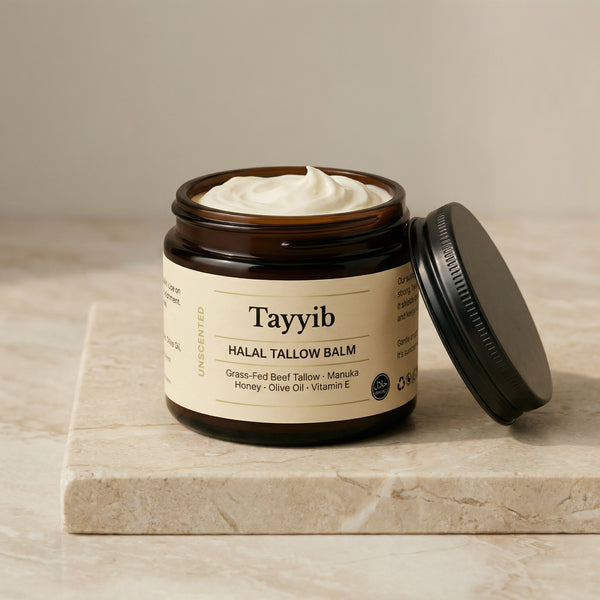
Tallow is useful here precisely because it is not exotic. It carries vitamins A, D, E and K and a fatty acid profile close to sebum, so it supports the barrier rather than asking it to absorb something it was never built to take in.
What to look for instead of collagen on a label
| Ingredient | What the evidence supports | Halal note |
|---|---|---|
| Retinoids | The best evidenced topical for collagen synthesis. Start low and infrequently. | Synthetic. Straightforward. |
| Vitamin C | A required cofactor for building collagen, plus antioxidant protection. | Synthetic or plant. Straightforward. |
| Peptides | Small enough to penetrate. Some signal for collagen production. | Usually synthetic. |
| Sunscreen | Prevents the UV damage that degrades collagen faster than you build it. | Check the carriers, not the filters. |
| Barrier lipids | Reduce the chronic low-grade inflammation that works against repair. | Depends on source. This is the tallow question. |
Where Tayyib Skincare stands
There is no collagen in our products, and that is deliberate rather than an omission. We would rather put in something that works through the barrier than something that sells well on a label.